Science

Subject Leader: Mrs P Taylor
Intent
At Netherton Church of England Primary School, we understand the need for all pupils to develop their scientific ability as an essential component of all subjects and as a subject in its own right. Through encouraging children to be inquisitive throughout their time at the school and beyond, we foster a healthy curiosity in children about our universe and promote respect - a key school value - for living organisms and the physical environment.
We believe that a high-quality science education provides the foundations for understanding the world through the specific disciplines of biology, chemistry and physics. Science continues to change our lives and is vital to the world’s future prosperity. All pupils should be taught essential aspects of the knowledge, methods, processes and application of science. They will be encouraged to understand how science can be employed to explain what is occurring, predict how things will behave, and analyse causes.
Science in our school is centred on developing children’s ideas and ways of working that enable them to make sense of the world in which they live through investigation, as well as using and applying process skills. We intend to provide all children, regardless of ethnic origin, gender, class, aptitude or disability, with a broad and balanced science curriculum, with the assurance that – as our school vision states – they ‘can do it’ and ‘can grow’.
Implementation
Through high quality teaching and learning experiences, children are encouraged to explore their outdoor environment and locality, thus developing their scientific enquiry and investigative skills. We strongly believe that any mathematical or English barriers should not impede a child’s scientific learning, thus meaning dialogic learning is a central part to our science teaching.
The science subject leader is responsible for the curriculum design, delivery and full coverage of the 'National Curriculum programmes of study for Science 2014'. This includes regular monitoring to review and quality assure that the coverage, breadth and balance is well-implemented. To ensure high standards of teaching and learning in science, we implement a curriculum that is progressive. We ensure that teachers have high expectations during the weekly science lessons and that any mathematical task (such as measuring or plotting graphs) is pitched at an age-appropriate level to ensure sufficient challenge. Assessments are made using ‘Exit Tickets’ each lesson and ‘Final Exit Tickets’ at the end of each unit of work. These, along with observations made, inform half-termly assessment judgements, which monitor progress made by the children and inform staff CPD. Based on teacher assessment, gap-filling sessions are timetabled based around the ‘Golden Nuggets’.
Teaching subject specific vocabulary is a key part of our science curriculum. Pupils are immersed in scientific vocabulary, which aids their knowledge and understanding not only of science but of the world around them. Key vocabulary is identified on the school’s medium-term planning and builds upon that which they have gained in previous years. It is shared and explored at the beginning and throughout each unit, included in the ‘exit ticket’ assessment tasks, and used by both staff and pupils verbally and in written work.
Impact
Our science curriculum ensures children not only acquire the appropriate age-related knowledge linked to the science curriculum, but also skills which equip them to progress from their starting points, and within their everyday lives.
All children will have: a wider variety of skills linked to both scientific knowledge, enquiry and understanding; a richer vocabulary, which will enable them to articulate their understanding of taught concepts; and high aspirations, which will see them through to further study, work and a successful adult life.
Characteristics of a Scientist
- inquisitive
- patient
- resilient
- open-minded
- analytical
- observant
- tenacious
Potential Careers
- astronomer
- astrophysicist
- biochemical engineer
- botanist
- cancer researcher
- chemist
- embryologist
- evolutionary biologist
- geneticist
- geologist
- laser physicist
- marine biologist
- meteorologist
- microbiologist
- microscopist
- molecular biologist
- neurophysiologist
- palaeontologist
- pathologist
- planetary physicist
- plant biologist
- veterinary surgeon
- virologist
- zoologist
Road Map
Useful Websites
- BBC Bitesize KS1 Science A wealth of materials to support home learning with videos, activities and games in all curriculum areas.
- BBC Bitesize KS2 Science A wealth of materials to support home learning with videos, activities and games in all curriculum areas.
- Maddie Moate The popular children's television presenter has her own YouTube channel and is delivering a daily science lesson "Let's Go Live with Maddie & Greg". Her channel has a wealth of educational videos.
- The Royal Institution - Science Lives Here - Experimental A series of short films, activities and resources making it fun, easy & cheap to do science experiments at home with children.
- Paignton Zoo - School from the Zoo Insightful video lessons to enjoy at school and at home to complement classroom learning.
- Paignton Zoo - Wild at Home A collection of downloadable resources to inspire and support science learning at school and home.
- Chester Zoo A range of resources to help with teaching & learning at home and school.
- Woodland Trust 10 nature activities for children to do at home.
- STEM Learning Primary science, maths, computing and DT resources and activities to support home learning.
- Science Museum Lots of learning resources including activities, games and videos.
- WOW Science Primary science activities, games & videos.
- Primary Science Teaching Trust - Science Fun at Home Fun science activities to try at home.
- Science Sparks Science Experiments for Kids.
- Sublime Science 101 fun science experiments you can do at home with 'stuff' you've already got.
- Marvin and Milo Lots of simple & exciting mini experiments to explore physics.
- Kids Invent Stuff This is a YouTube channel engaging children in real engineering projects with a chance to get their invention ideas built by real engineers. A new challenge is set each month.
- Space Related Educational Resources for Home Learning A collection of space related educational resources published by the UK Space Agency.
All Aboard for Engineering!
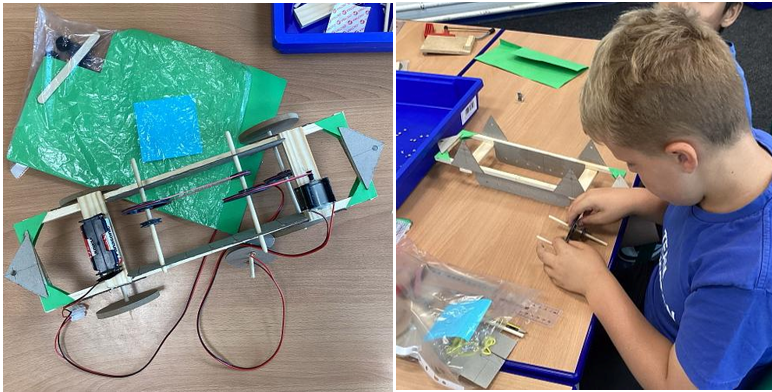
This year, our children had the exciting opportunity to take part in the Primary Engineer Rail Programme, a hands-on project combining engineering, Design and Technology, mathematics and problem-solving.
The children designed and built their own locomotives, developing practical skills as they measured, cut, sawed and assembled their creations. Our Year 1 children built wheeled locomotives with a simple braking system, while Year 4 took on an additional electrical challenge, constructing circuits using batteries, wires, a reversible switch and a motor to drive a series of pulleys.
The children then put their engineering skills to the test. Year 1 tested whether their locomotives could travel along the track and stop at the station, while Year 4 tested whether their electrical systems allowed their locomotives to move forwards and backwards.
The programme culminated in a celebration where the children judged the locomotives against a set of criteria before voting for the winners. They thoroughly enjoyed the whole experience and demonstrated creativity, teamwork, problem-solving and perseverance throughout.
We are extremely grateful to the generous people at Stourbridge Lion 2029, whose funding made it possible for our school to take part in this fantastic programme.
Science Book Quiz
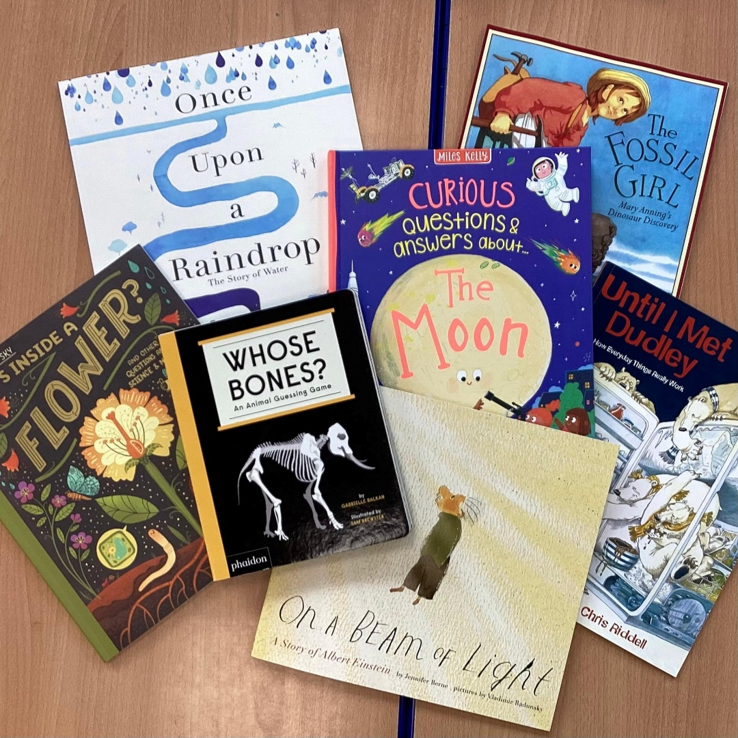
In July, a team of children from 4T took part in an exciting Science Book Quiz with several other local schools involved in the Dudley Partnership of The Ogden Trust. The Ogden Trust works with schools to strengthen physics education and provide pupils with engaging opportunities to develop their interest and enthusiasm for science.
The quiz took place via Zoom, with all of the questions based on a selection of science books. Our children had the opportunity to demonstrate both their scientific knowledge and their reading skills as they answered questions alongside teams from the other schools.
We were absolutely delighted when our team finished as joint winners!
As part of the experience, we were also able to keep the collection of science books. The books are now available for children across the school to explore and enjoy during their reading-for-pleasure time, giving even more pupils the opportunity to discover the fascinating world of science.
It was a fantastic opportunity to bring together two things we love at school — science and reading — while allowing our children to share their enthusiasm with other schools. We are incredibly proud of their achievement!